Clinicians continue to seek treatment options that provide efficacy and safety2,3

Despite the fact that a multitude of treatments have been examined, no standard of care has been established for patients with triple-class–exposed RRMM.

Dozens of treatment combinations, no standard of care2,3

The LocoMMotion and MoMMent studies were conducted to assess real-world physician's choice of therapy in patients with RRMM. These studies illustrated that no clear standard of care exists for patients with triple-class–exposed RRMM. In the real-world physician's choice of therapy cohort, 74 treatment combinations were used; of the regimens prescribed, only 3 were prescribed to >10% of patients.

Treatment regimens in the real-world physician's choice of therapy cohort4
Treatment regimen*Frequency, n (%) (n=177)
Pomalidomide, cyclophosphamide, and dexamethasone29 (16.4)
Pomalidomide and dexamethasone21 (11.9)
Carfilzomib and dexamethasone18 (10.2)
Belantamab mafodotin10 (5.6)
Panobinostat, bortezomib, and dexamethasone8 (4.5)
Carfilzomib, cyclophosphamide, and dexamethasone8 (4.5)
Elotuzumab, pomalidomide, and dexamethasone7 (4.0)
Carfilzomib, lenalidomide, and dexamethasone6 (3.4)
Ixazomib, lenalidomide, and dexamethasone6 (3.4)
Bortezomib, bendamustine, and dexamethasone4 (2.3)
Carfilzomib, pomalidomide, and dexamethasone4 (2.3)
Lenalidomide and dexamethasone4 (2.3)
Daratumumab, bortezomib, and dexamethasone3 (1.7)
Cyclophosphamide and dexamethasone3 (1.7)
Daratumumab, pomalidomide, and dexamethasone3 (1.7)
Melphalan and dexamethasone3 (1.7)
Melphalan3 (1.7)
Idecabtagene vicleucel3 (1.7)

*Only treatments used in ≥3 patients are presented.

Percentages were calculated with the number of patients in the all-treated analysis set as denominator (N=177).

Achieving efficacy becomes increasingly challenging2

As patients with MM progress through therapies, it becomes increasingly difficult to find treatments that provide efficacy

The LocoMMotion and MoMMent studies were conducted to assess the effectiveness and safety of real-world physician's choice of therapy in triple-class–exposed patients with RRMM.2

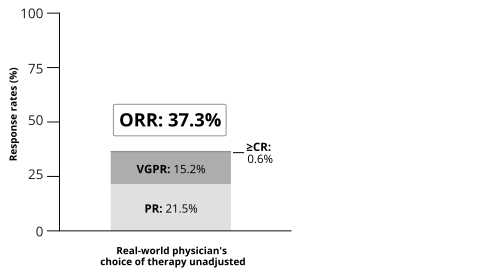
Observed response rates in the real-world physician's choice of therapy cohort (n=177)2,5
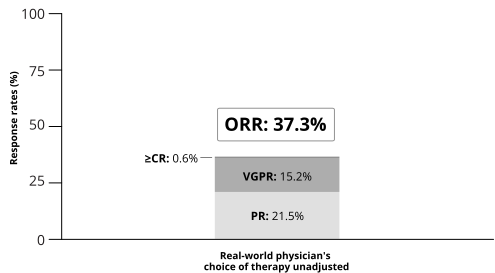
Observed response rates, graph

The mean duration of response was 9 months (95% CI, range: 5.75–14.42 months) (n=66).

Chess pieces on a chess board, banner

    1. Kurtin S. Relapsed or relapsed/refractory multiple myeloma. J Adv Pract Oncol. 2013;4(6):1–14.
    2. Einsele H, Moreau P, Bahlis N, et al. Adv Ther. 2024;41(4):1576–1593. doi:10.1007/s12325-024-02797-x
    3. Mateos MV, Weisel K, De Stefano V, et al. LocoMMotion: a prospective, non-interventional, multinational study of real-life current standards of care in patients with relapsed and/or refractory multiple myeloma. Leukemia. 2022;36(5):1371–1376.
    4. Einsele H, Moreau P, Bahlis N, et al. Adv Ther. 2024;41(4)(SUPPl):1576–1593. doi:10.1007/s12325-024-02797-x
    5. Data on file. Janssen Biotech, Inc.
    6. Mikhael J. Treatment options for triple-class refractory multiple myeloma. Clin Lymphoma Myeloma Leuk. 2020;20(1):1–7.
    7. Usmani S, Ahmadi T, Ng Y, et al. Analysis of real-world data on overall survival in multiple myeloma patients with ≥3 prior lines of therapy including a proteasome inhibitor (PI) and an immunomodulatory drug (IMiD), or double refractory to a PI and an IMiD. Oncologist. 2016;21(11):1355–1361.