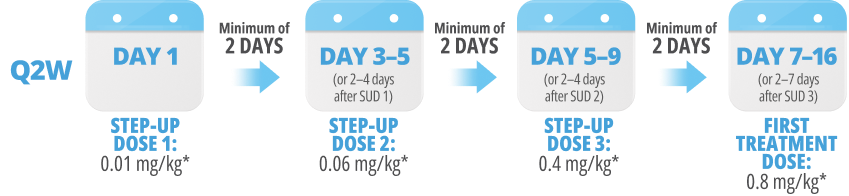
TALVEY® (talquetamab-tgvs) dosing calendar for Q2W dosing

Following step-up dosing, ongoing biweekly dosing begins. Maintain a minimum of 12 days between Q2W doses. TALVEY® is given until disease progression or unacceptable toxicity.
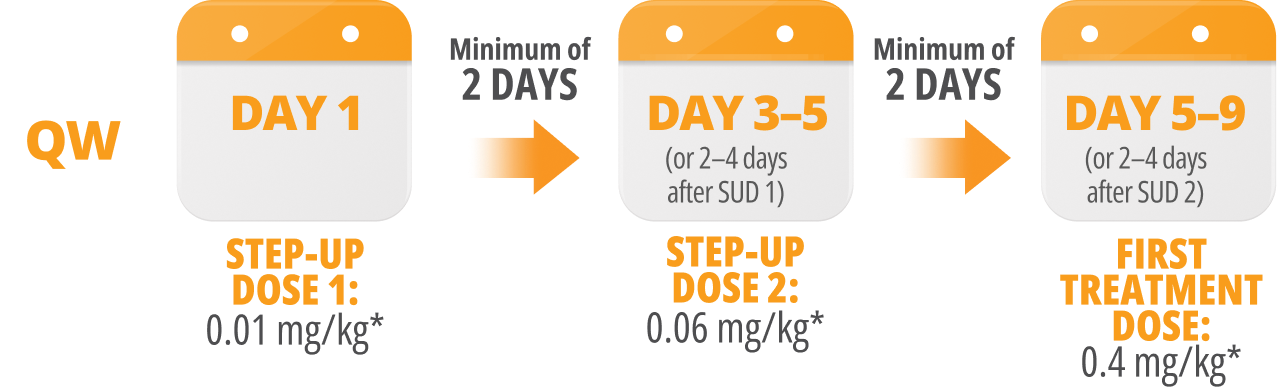
TALVEY® (talquetamab-tgvs) dosing calendar for QW dosing

Following step-up dosing, ongoing weekly dosing begins. Maintain a minimum of 6 days between QW doses. TALVEY® is given until disease progression or unacceptable toxicity.

*Based on actual body weight.

You make the move with step-up dosing flexibility.

Step-up doses may be administered between 2 to 4 days after the previous dose and may be given up to 7 days after the previous dose to allow for resolution of adverse reactions. If time is not needed to resolve an adverse reaction, the full step-up dosing schedule can be completed in 7 days for Q2W and 5 days for QW.

Dosing considerations

Initiate TALVEY® treatment with step-up dosing to reduce the risk of CRS. Dose delays may be required to manage toxicities.

  • Due to the risk of CRS and neurologic toxicity, including ICANS, patients should be hospitalized for 48 hours after administration of all doses within the TALVEY® step-up dosing schedule
  • Rapid subcutaneous injection: TALVEY® does not require the wait time associated with infusions1,2†
  • Ready-to-use solution without need for dilution
  • Subcutaneous injection into abdomen (preferred) or thigh. Use aseptic technique to prepare and administer TALVEY®
  • Do not combine TALVEY® vials of different concentrations to achieve treatment dose1
  • Parenteral drug products should be inspected visually for particulate matter and discoloration prior to administration, whenever solution and container permit. Check that the TALVEY® solution for injection is colorless to light yellow. Do not use if the solution is discolored, cloudy, or if foreign particles are present

Personalized weight-based dosing

  • Please refer to Tables 9-12 in the current full Prescribing Information to determine total dose, injection volume, and number of vials required

1 to 3 hours before each step-up dose

Administer the following pretreatment medications before each dose in the step-up dosing schedule to reduce the risk of CRS:

  • Corticosteroids (oral or intravenous dexamethasone 16 mg or equivalent)
  • Antihistamines (oral or intravenous diphenhydramine 50 mg or equivalent)
  • Antipyretics (oral or intravenous acetaminophen 650 mg to 1000 mg or equivalent)

Subsequent doses

Administration of pretreatment medications may be required for subsequent doses for patients who repeat doses within the TALVEY® step-up dosing schedule due to dose delays or for patients who experienced CRS.

View dose modification recommendations for the management of adverse reactions

Recommendations for management of CRS1

CRS Grade*Presenting symptomsActions
Grade 1Temperature ≥100.4°F (38°C)
  • Withhold TALVEY® until CRS resolves
  • Administer pretreatment medication prior to next dose
Grade 2Temperature ≥100.4°F (38°C) with either:
  • Hypotension responsive to fluids and not requiring vasopressors, or
  • Oxygen requirement of low-flow nasal cannula§ or blow-by
  • Withhold TALVEY® until CRS resolves
  • Administer pretreatment medications prior to next dose
  • Patients should be hospitalized for 48 hours following the next dose
Grade 3Temperature ≥100.4°F (38°C) with either:
  • Hypotension requiring 1 vasopressor, with or without vasopressin, or
  • Oxygen requirement of high-flow nasal cannula,§ facemask, nonrebreather mask, or Venturi mask

Duration less than 48 hours

  • Withhold TALVEY® until CRS resolves
  • Provide supportive therapy, which may include intensive care
  • Administer pretreatment medications prior to next dose
  • Patients should be hospitalized for 48 hours following the next dose

Recurrent or duration greater than or equal to 48 hours

  • Permanently discontinue TALVEY®
  • Provide supportive therapy, which may include intensive care
Grade 4Temperature ≥100.4°F (38°C) with either:
  • Hypotension requiring multiple vasopressors (excluding vasopressin)
  • Or, oxygen requirement of positive pressure (eg, continuous positive airway pressure, bilevel positive airway pressure, intubation, and mechanical ventilation)
  • Permanently discontinue TALVEY®
  • Provide supportive therapy, which may include intensive care

Recommendations for management of ICANS1

ICANS Grade*Presenting symptomsActions
Grade 1

ICE score 7-9,

or depressed level of consciousness§: awakens spontaneously.

  • Withhold TALVEY® until ICANS resolvesǁ
  • Monitor neurologic symptoms and consider consultation with neurologist and other specialists for further evaluation and management
  • Consider nonsedating antiseizure medicines (eg, levetiracetam) for seizure prophylaxis
Grade 2

ICE score 3-6,

or depressed level of consciousness§: awakens to voice.

  • Withhold TALVEY® until ICANS resolves
  • Administer dexamethasone 10 mg intravenously every 6 hours. Continue dexamethasone use until resolution to Grade 1 or less, then taper
  • Monitor neurologic symptoms and consider consultation with neurologist and other specialists for further evaluation and management
  • Consider nonsedating antiseizure medicines (eg, levetiracetam) for seizure prophylaxis
  • Patients should be hospitalized for 48 hours following the next dose of TALVEY®ǁ
Grade 3

ICE score 0-2, if ICE score is 0, but the patient is arousable (eg, awake with global aphasia) and able to perform assessment,

or depressed level of consciousness§: awakens only to tactile stimulus,

or seizures,§ either:

  • any clinical seizure, focal or generalized, that resolves rapidly, or
  • nonconvulsive seizures on electroencephalogram (EEG) that resolve with intervention,

or raised intracranial pressure: focal/local edema on neuroimaging.§

First occurrence of Grade 3 ICANS:

  • Withhold TALVEY® until ICANS resolves
  • Administer dexamethasone 10 mg intravenously every 6 hours. Continue dexamethasone use until resolution to Grade 1 or less, then taper
  • Monitor neurologic symptoms and consider consultation with neurologist and other specialists for further evaluation and management
  • Consider nonsedating antiseizure medicines (eg, levetiracetam) for seizure prophylaxis
  • Patients should be hospitalized for 48 hours following the next dose of TALVEY®ǁ

Recurrent Grade 3 ICANS:

  • Permanently discontinue TALVEY®
  • Administer dexamethasone 10 mg intravenously and repeat dose every 6 hours. Continue dexamethasone use until resolution to Grade 1 or less, then taper
  • Monitor neurologic symptoms and consider consultation with neurologist and other specialists for further evaluation and management
  • Consider nonsedating antiseizure medicines (eg, levetiracetam) for seizure prophylaxis
  • Provide supportive therapy, which may include intensive care
Grade 4

ICE score 0 (patient is unarousable and unable to perform ICE assessment)

or depressed level of consciousness,§ either:

  • patient is unarousable or requires vigorous or repetitive tactile stimuli to arouse, or
  • stupor or coma,

or seizures,§ either:

  • life-threatening prolonged seizure (>5 minutes), or
  • repetitive clinical or electrical seizures without return to baseline in between,

or motor findings§:

  • deep focal motor weakness such as hemiparesis or paraparesis,

or raised intracranial pressure/cerebral edema,§ with signs/symptoms such as:

  • diffuse cerebral edema on neuroimaging, or
  • decerebrate or decorticate posturing, or
  • cranial nerve VI palsy, or
  • papilledema, or
  • Cushing’s triad
  • Permanently discontinue TALVEY®
  • Administer dexamethasone 10 mg intravenously and repeat dose every 6 hours. Continue dexamethasone use until resolution to Grade 1 or less, then taper
  • Alternatively, consider administration of methylprednisolone 1000 mg per day intravenously and continue methylprednisolone 1000 mg per day intravenously for 2 or more days
  • Monitor neurologic symptoms and consider consultation with neurologist and other specialists for further evaluation and management
  • Consider nonsedating antiseizure medicines (eg, levetiracetam) for seizure prophylaxis
  • Provide supportive therapy, which may include intensive care

Recommendations for management of neurologic toxicity (excluding ICANS)

Adverse reactionSeverity*Actions
Neurologic toxicity* (excluding ICANS)

Grade 1

  • Withhold TALVEY® until neurologic toxicity symptoms resolve or stabilize†‡

Grade 2

Grade 3 (First occurrence)

  • Withhold TALVEY® until neurologic toxicity symptoms improve to Grade 1 or less†‡
  • Provide supportive therapy

Grade 3 (Recurrent)

Grade 4

  • Permanently discontinue TALVEY®
  • Provide supportive therapy, which may include intensive care

Recommendations for management of other adverse reactions1

Adverse reactionSeverityDose modification
Oral toxicity and weight loss

Grade 1/2

  • Provide supportive care
  • Consider interrupting TALVEY® if patient is not responsive to supportive care*

Grade 3

  • Withhold TALVEY® until resolution to Grade 1 or better and provide supportive care*

Grade 4

  • Permanently discontinue TALVEY®
Infections

All Grades

  • Withhold TALVEY® in the step-up phase in patients until infection resolves

Grade 3

  • Withhold TALVEY® during the treatment phase until infection improves to Grade 1 or better within 28 days

Grade 4

Consider permanent discontinuation of TALVEY®.

  • If TALVEY® is not permanently discontinued, withhold subsequent treatment doses of TALVEY® (ie, doses administered after TALVEY® step-up dosing schedule) until adverse reaction improves to Grade 1 or better
Cytopenias

Absolute neutrophil count less than 0.5 × 10⁹/L

  • Withhold TALVEY® until absolute neutrophil count is 0.5 × 10⁹/L or higher*

Febrile neutropenia

  • Withhold TALVEY® until absolute neutrophil count is 1.0 × 10⁹/L or higher and fever resolves*

Hemoglobin less than 8 g/dL

  • Withhold TALVEY® until hemoglobin is 8 g/dL or higher*

Platelet count less than 25,000/mcL

Platelet count between 25,000/mcL and 50,000/mcL with bleeding

  • Withhold TALVEY® until platelet count is 25,000/mcL or higher and no evidence of bleeding*
Skin reactions

Grade 3/4

  • Withhold TALVEY® until adverse reaction improves to Grade 1 or baseline*
Other nonhematologic adverse reactions

Grade 3

  • Withhold TALVEY® until adverse reaction improves to Grade 1 or baseline*

Grade 4

Consider permanent discontinuation of TALVEY®.

  • If TALVEY® is not permanently discontinued, withhold subsequent treatment doses of TALVEY® (ie, doses administered after TALVEY® step-up dosing schedule) until adverse reaction improves to Grade 1 or less*

Restarting TALVEY® after dose delay

Restarting TALVEY® on a weekly dosing schedule1

Last dose administeredTime from last dose administeredTALVEY® recommendation*
0.01 mg/kgMore than 7 daysRestart TALVEY® step-up dosing schedule at step-up dose 1 (0.01 mg/kg).
0.06 mg/kg

8 to 28 days

Repeat step-up dose 2 (0.06 mg/kg) and continue TALVEY® step-up dosing schedule.

More than 28 days

Restart TALVEY® step-up dosing schedule at step-up dose 1 (0.01 mg/kg).

0.4 mg/kg

8 to 28 days

Continue TALVEY® dosing schedule at treatment dose (0.4 mg/kg weekly).

29 to 56 days

Restart TALVEY® step-up dosing schedule at step-up dose 2 (0.06 mg/kg).

More than 56 days

Consider permanent discontinuation. If restarting TALVEY®, begin with the step-up dosing schedule at step-up dose 1 (0.01 mg/kg).

Restarting TALVEY® on a biweekly dosing schedule

Last dose administeredTime from last dose administeredTALVEY® recommendation
0.01 mg/kgMore than 7 daysRestart TALVEY® step-up dosing schedule at step-up dose 1 (0.01 mg/kg).
0.06 mg/kg8 to 28 daysRepeat step-up dose 2 (0.06 mg/kg) and continue TALVEY® step-up dosing schedule.
More than 28 daysRestart TALVEY® step-up dosing schedule at step-up dose 1 (0.01 mg/kg).
0.4 mg/kg8 to 28 daysRepeat step-up dose 3 (0.4 mg/kg) and continue TALVEY® step-up dosing schedule.
29 to 56 daysRestart TALVEY® step-up dosing schedule at step-up dose 2 (0.06 mg/kg).
More than 56 daysConsider permanent discontinuation. If restarting TALVEY®, begin with the step-up dosing schedule at step-up dose 1 (0.01 mg/kg).
0.8 mg/kg15 to 28 daysContinue TALVEY® dosing schedule at treatment dose (0.8 mg/kg every 2 weeks).
29 to 56 daysRestart TALVEY® step-up dosing schedule at step-up dose 3 (0.4 mg/kg).
More than 56 daysConsider permanent discontinuation. If restarting TALVEY®, begin with the step-up dosing schedule at step-up dose 1 (0.01 mg/kg).

    1. TALVEY® [Prescribing Information]. Horsham, PA: Janssen Biotech, Inc.
    2. Kim H, Park H, Lee SJ. Effective method for drug injection into subcutaneous tissue. Sci Rep. 2017;7(1):9613.